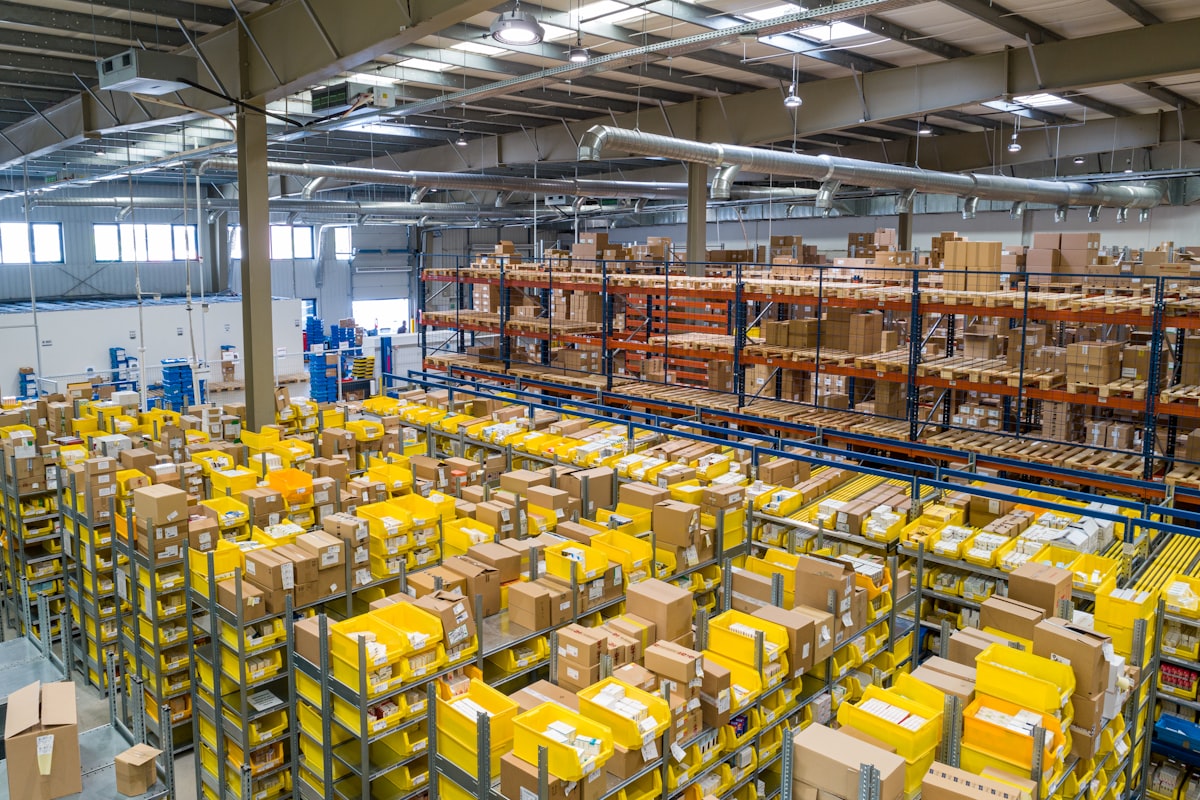
Logistics & 3PL
Reduction in distribution costs
Off delivery turnaround


About
A logistics operator using a legacy routing tool that could not account for real-time traffic or dynamic delivery windows. We deployed a reinforcement learning route optimisation engine integrated with their WMS.
Industry
Logistics & 3PL
Company size
5,000 – 10,000 employees
Founded
1978
The Company
A high-complexity production operation running below its potential
Meridian Manufacturing operates three production facilities producing a range of consumer packaged goods across 45 active SKUs. The business runs a 24-hour, six-days-per-week production schedule across 12 production lines with varying capabilities, capacities, and maintenance requirements. Demand variability is high, with seasonal peaks that require rapid shifts in production priorities and SKU allocation.
Despite strong operational experience across its facilities, the business was chronically underperforming against its theoretical production capacity. The combination of suboptimal scheduling, unmanaged maintenance events, and poor changeover sequencing was costing the business output it could not easily quantify — until Seven Billion was brought in to measure it.
The challenge
Manual scheduling cannot optimise what the human mind cannot simultaneously hold
Production scheduling at Meridian was managed manually by a planning team using a combination of ERP data and spreadsheet tools. The scheduling process involved manually matching SKUs to production lines based on equipment compatibility, assigning batch quantities, and sequencing runs — a process that took experienced planners two to three days every week and still produced schedules that were frequently suboptimal.
The core limitation of the manual approach was that it could not simultaneously optimise across all the variables that determine a good production schedule. A planner could factor in line compatibility and batch size, but could not dynamically account for predicted maintenance windows, changeover time minimisation across SKU sequences, or real-time capacity updates when a line went offline unexpectedly.
The result was chronic underutilisation — lines idling between runs due to poor sequencing, changeovers running longer than necessary because SKU sequences were not optimised for setup time, and maintenance disruptions cascading through the schedule because the planning model had no mechanism for predictive maintenance integration.
The Solution
Real-time scheduling optimisation integrated with predictive maintenance
Seven Billion built a real-time production scheduling optimiser using a Mixed Integer Programming model implemented in Gurobi, connected to Azure SQL for live data access and integrated with the facility's production management system.
The optimiser simultaneously solved for four objectives: maximise total production output by assigning SKUs to lines and sequencing runs to minimise idle time and changeover delay; minimise changeover time by sequencing SKU runs to minimise total setup and cleaning time based on a pre-defined changeover matrix; respect maintenance constraints by integrating predictive maintenance windows as hard scheduling constraints; and balance line utilisation across facilities to avoid overloading high-capacity lines while underutilising others.
The system was configured to regenerate an optimised schedule every four hours, or on-demand following any production event requiring replanning. Planners could view the current optimised schedule, see projected utilisation for each line, and make manual overrides where local knowledge required — with the system automatically recalculating the downstream impact of any override.
The Results
The equivalent of two new production lines — without capital investment
Production line utilisation increased by 21% in the first quarter of deployment — the equivalent of gaining the output of approximately two additional production lines without any capital investment. Unplanned downtime reduced by 18%, driven primarily by the integration of predictive maintenance windows into the scheduling model, which eliminated the pattern of scheduling production runs immediately before predicted maintenance events.
Changeover time reduced by 14% through SKU sequence optimisation that minimised cumulative cleaning and setup time across all line transitions in each 24-hour schedule. Weekly planning effort reduced from three days to approximately four hours, with planners redirecting the saved time to supply chain coordination rather than schedule construction.
The Rs. 1.8 Cr in estimated annual savings represented the measurable financial impact — but the operational team noted that the shift from reactive scheduling to proactive, optimised planning had changed the character of how the facilities were managed, not just the output numbers.

The optimiser found sequencing patterns that our planners had never considered — not because they are not good at their jobs, but because the number of variables is simply beyond what any person can simultaneously optimise. The results showed up immediately.
Head of Manufacturing Operations, Meridian Manufacturing
KEEP READING
Explore more studies on AI, analytics, and enterprise intelligence.