Accelerators
›Purpose-built LLM systems, multi-agent reasoning workflows, and domain-adapted models.
Universal semantic metric layers, natural language querying, and executive intelligence.
Mathematical constraint solvers (MILP, CP-SAT) for scheduling, allocation, and routing.
Pragmatic ERP modernisation, event-driven API mesh, and custom operational applications.
Industry Trends in AI & Analytics
Practical benchmarks on what actually works when moving AI from pilot to production.



A master production schedule (MPS) decides which finished products to make, how many and when. Material requirements planning (MRP) works out which parts and raw materials that schedule needs, and when to order them. Advanced planning and scheduling (APS) decides which order runs on which line, in what sequence, within the capacity the plant really has. In plants that already run MRP and still ship late, the cause usually sits in the gap between those last two layers.
MPS, MRP and APS in one table
Each layer answers a narrower question over a shorter horizon. S&OP balances demand and supply by product family. MPS commits to finished quantities. MRP turns that commitment into purchase and production orders. A rough-cut check tests whether key work centers can bear the load. APS sequences the work on real resources, and MES dispatches it to the floor.
Layer | Question it answers | Typical horizon | Capacity model | Who owns it | Where it usually lives |
|---|---|---|---|---|---|
S&OP (context) | How much can we sell and supply, by family? | 3 to 18 months | Aggregate, by family | Business leadership | Spreadsheets or a planning tool |
MPS | Which finished SKUs, how many, in which period? | Weeks to months | Checked roughly, if at all | Master scheduler | ERP |
MRP | Which parts and materials, how many, ordered when? | Weeks to months | Assumes unlimited capacity, fixed lead times | Material planners | ERP |
Rough-cut capacity (RCCP) | Does the total load fit a key work center this week? | Weeks | Aggregate check by work center and week | Master scheduler | ERP or spreadsheet |
APS / finite scheduling | Which order runs on which line, in what sequence? | Shift to a few weeks | Finite: every resource has a calendar | Production planner | Scheduling layer on top of the ERP |
MES dispatch | What runs on this machine right now? | Minutes to a shift | Live state of the floor | Shift supervisor | MES |
What a master production schedule decides
Independent demand in, a production commitment out
The MPS takes independent demand, meaning forecasts and customer orders for finished goods, and converts it into planned quantities per SKU per period. It does not look inside the product. A master scheduler nets those requirements against finished stock and safety stock, then sets the build quantity that everything downstream will chase.
Here is an illustrative example. A snack maker forecasts 12,000 cases of a 200 g pack for week 3, holds 2,000 in stock and wants 1,000 as a buffer, so the MPS line for week 3 reads 11,000 cases. That figure becomes a promise the purchasing team and the plant both plan against.
Time fences and why planners freeze the near term
A time fence marks the point inside which the schedule should not change without a deliberate decision. Inside the frozen zone, materials are already bought and lines are already booked, so a late change costs real money. Further out, the plan stays open to new forecasts. Most ERPs let the scheduler set a demand fence and a planning fence per item.
What MRP decides, and the assumption that bites
BOM explosion, netting and lead time offset
MRP reads the MPS and explodes each finished item through its bill of materials (BOM) to find dependent demand for every component. It nets that demand against on-hand and incoming stock, then offsets each requirement by the component's lead time to produce planned orders.
Staying with the illustrative snack: each case needs 24 pouches of film. 11,000 cases call for 264,000 pouches. With 64,000 on hand and a two-week supplier lead time, MRP proposes a purchase order for 200,000 pouches, released two weeks before week 3 starts.
The infinite-capacity assumption
MRP will place five planned orders on a line that can run three. That is by design. It is a material calculation, so it assumes every work center can absorb whatever it releases and that lead times hold regardless of load. It has no idea that moving from a spicy flavour back to a plain one means a forty-minute wash.
This is the crux. MRP can be perfectly correct about materials and still hand the shop floor a plan nobody can run. Most ERPs bolt on a rough-cut check by week, which flags an overloaded work center but does not say which order should move.
What APS adds: a plan the line can run
APS, or finite capacity scheduling, places each operation on a specific resource and time slot, and only where capacity really exists. It takes the planned orders MRP produced and returns a sequence that respects machines, people, materials and setups. The output is a schedule the shift can follow as written.
It respects:
line and machine capacity, with each resource on its own calendar
shifts, operator skills and maintenance windows
tooling and other shared resources
material arrival, so nothing is scheduled before its components land
sequence-dependent changeovers, taken from the plant's changeover matrix
plant-specific rules, such as the blast-freezer curves a dairy manufacturer we worked with had to honour
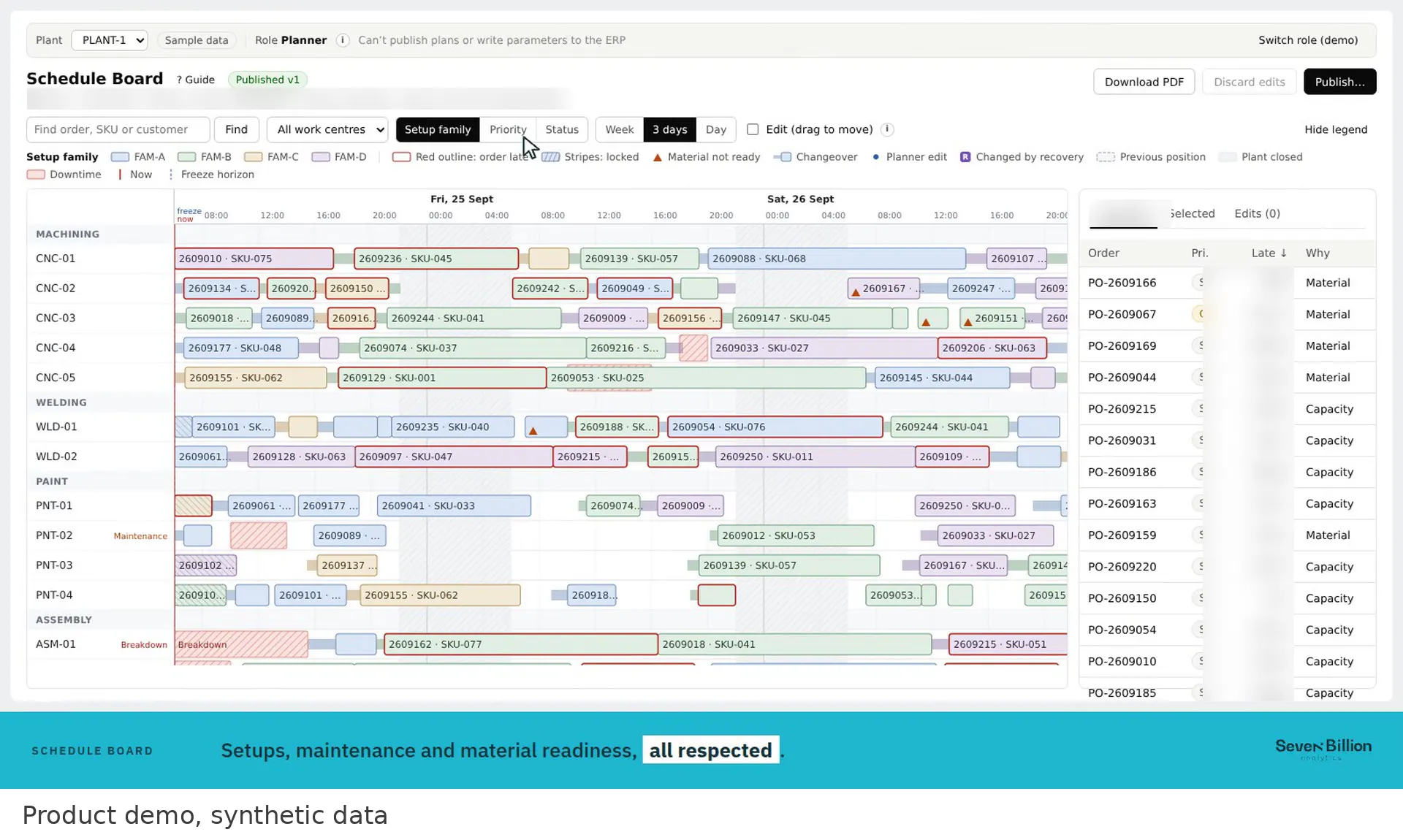
This is what our finite capacity production scheduling work produces. For the step-by-step on how an AI scheduler builds that plan, see how mid-size manufacturers schedule production with AI.
Where plans break between the layers
MPS is feasible on paper, MRP releases on time, the line still overloads
A rough-cut check might show packing at 90% for the week, which looks fine. Inside that week, though, Tuesday carries three days of work because two big orders share a due date. Materials arrive exactly as MRP promised, and the line still runs late. Live line data from plant data and OEE visibility tells the scheduler what capacity truly is, rather than what the routing says it should be.
Promo spikes and rush orders hit after the MPS is frozen
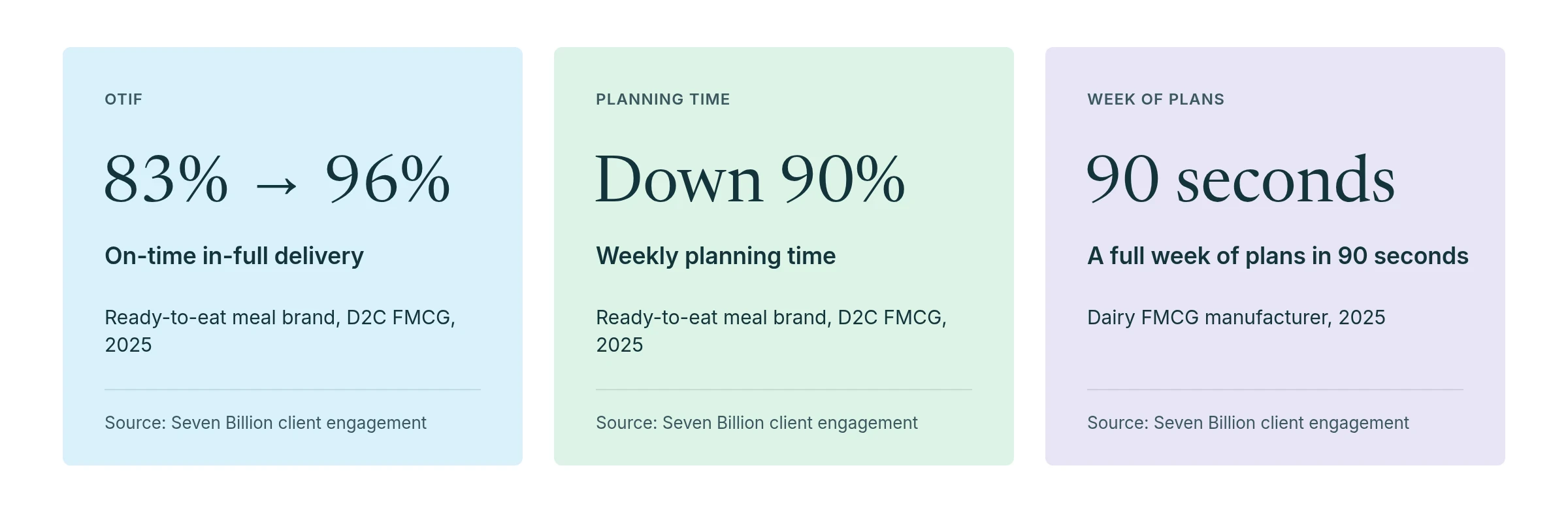
At a ready-to-eat meal brand, promo spikes that the spreadsheet missed forced 8-hour planning sessions, and OTIF was stuck at 83%. The MPS had been set before the promo volume was visible. Every spike then had to be squeezed through a frozen plan by hand, which is exactly the work MRP cannot do.
Changeover cost hidden from MRP
A dairy FMCG manufacturer with freezer-constrained lines lost ₹46 lakh in changeovers each season to overlapping runs and freezer bottlenecks. Raw material lead times of 30 days made it harder still. None of that cost shows up in an MRP run, because MRP does not model sequence. It only appears once someone schedules the runs against the freezers.
Batch sizing decided by habit, not math
Lot sizes in an ERP are often a fixed number someone set years ago. At one food producer, a mixed-integer optimiser sized production batches instead. Lost sales fell 25% and waste fell 15%. The planning layers were the same; the batch rule underneath them changed.
When your ERP planning module is enough
Sometimes the honest answer is that you do not need APS. If you run one line or a few, with long runs, low changeover costs and steady demand, MRP plus a rough-cut check will usually get you close. A good planner with a whiteboard fills the remaining gap at no extra licence cost.
You have outgrown it when:
planners re-sequence the ERP's plan in Excel every day
the schedule lives in one senior planner's head, and holidays hurt
expedites have become routine rather than exceptions
OTIF slips while the materials are sitting in the store
That last signal matters most. Late orders with materials in stock point to sequencing and capacity, which is the layer MRP does not cover.
Adding a scheduling layer without replacing the ERP
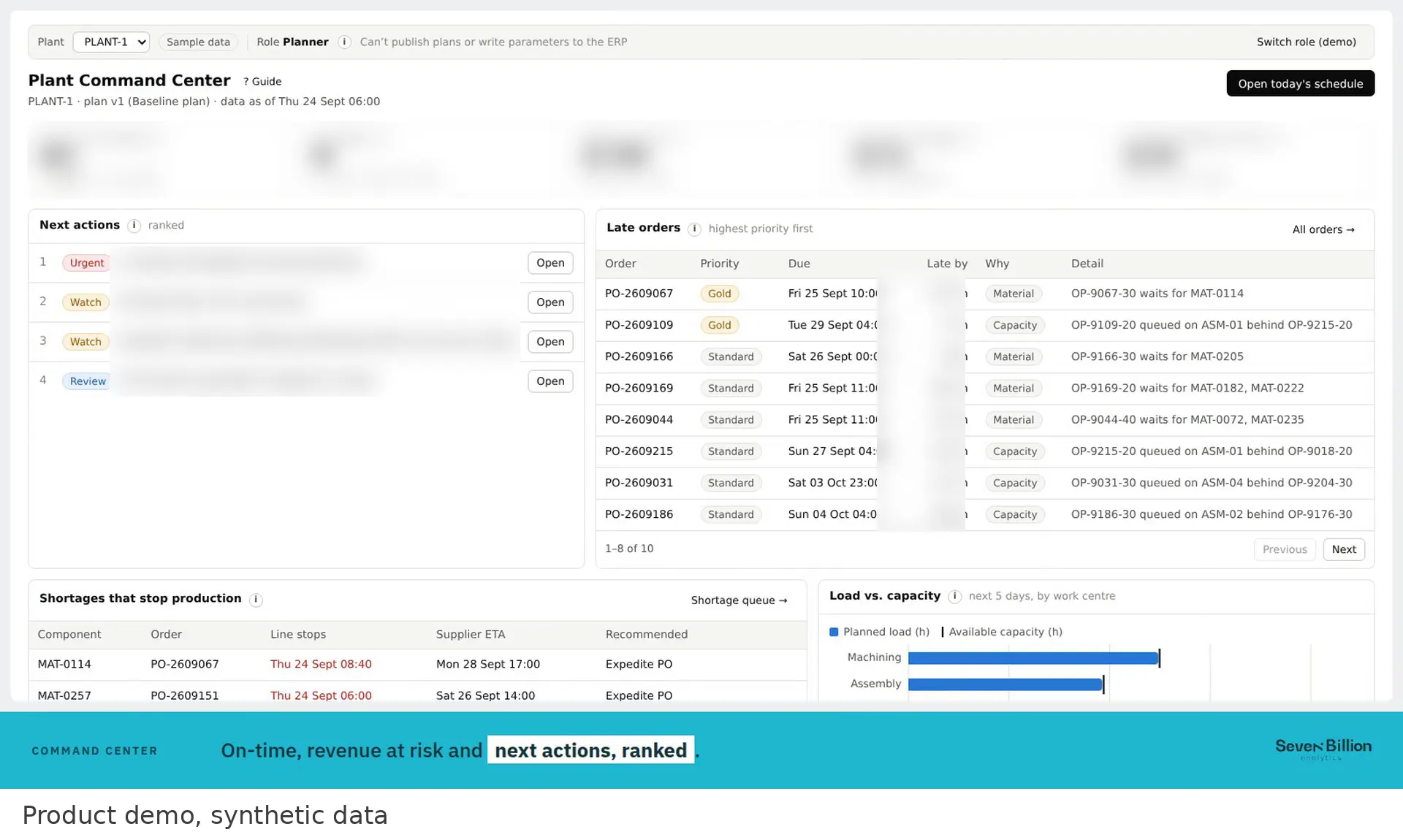
The ERP stays the system of record for MPS, MRP, orders and finance. A scheduler reads planned orders, routings, BOMs and calendars, for example from SAP S/4HANA PP, along with the machine calendar and the changeover matrix. It returns a sequenced Gantt, realistic promise dates and a material expedite list. A planner reviews and approves the plan before anything is written back.
In one ready-to-eat meal plant, OTIF rose from 83% to 96% and planning time fell 90% once a scheduling engine replaced spreadsheet planning (2025). At a dairy plant of the type described above, a full week of plans now generates in 90 seconds, and planners compare five scenarios in under five minutes (2025). Neither is a guarantee for another plant.
Choosing between a packaged APS, a fitted scheduler and the ERP's own module is a separate decision, and we will cover it in a dedicated comparison.
FAQ
What is the difference between MPS, MRP and APS?
MPS sets which finished products to make, how many and when. MRP uses the bill of materials to work out which parts and raw materials are needed, and when to order them. APS turns those orders into a sequence on each line that fits real capacity, shifts and changeovers. MPS and MRP plan quantities; APS plans what the plant can actually run.
Why does MRP assume infinite capacity?
MRP was designed as a material calculation: it nets requirements and offsets them by fixed lead times. It does not check whether a work center can run everything it releases, or what changeovers cost. Most ERPs add only a rough-cut capacity check by week, so overloads surface on the shop floor, where planners fix them by hand.
Do I need APS if my ERP already does MPS and MRP?
Not always. If you run few lines, long runs and low changeover costs, the ERP plus a rough-cut check can be enough. If planners re-sequence in Excel every day, expedites are routine and orders ship late while materials are in stock, the missing piece is usually finite scheduling, added on top of the ERP rather than replacing it. Book an architecture review to find out which case you are in.
Is production planning the same as production scheduling?
No. Planning decides what and how much to make over weeks or months (MPS, MRP). Scheduling decides the exact order, line and time over the next shift, day or week, within real capacity. A plan can be correct and still impossible to run; the schedule is where that gets resolved.
What is rough-cut capacity planning, and how is it different from finite scheduling?
Rough-cut capacity planning checks whether total load on a key work center fits in a week or month. Finite scheduling places each operation on a specific resource and time slot, including setups and shifts. RCCP tells you a week is overloaded; finite scheduling tells you which order moves and what gets late.
Can an APS layer improve on-time delivery?
It is built to, by sequencing to protect due dates and cut changeovers, but results depend on the plant. In one ready-to-eat meal brand, OTIF rose from 83% to 96% after a scheduling and planning engine replaced spreadsheet planning (2025). That is one case, not a guarantee.
Not sure which layer is breaking?
Book an architecture review. We look at your ERP planning data and show a shadow schedule on your own orders. To see the layer itself, read how our finite capacity production scheduling works.
KEEP READING
Explore more perspectives on AI, analytics, and enterprise intelligence.