Accelerators
›Purpose-built LLM systems, multi-agent reasoning workflows, and domain-adapted models.
Universal semantic metric layers, natural language querying, and executive intelligence.
Mathematical constraint solvers (MILP, CP-SAT) for scheduling, allocation, and routing.
Pragmatic ERP modernisation, event-driven API mesh, and custom operational applications.
Industry Trends in AI & Analytics
Practical benchmarks on what actually works when moving AI from pilot to production.


Most mid-size plants schedule production the same way: the ERP sets due dates, and a planner turns them into a sequence in Excel. This article explains what changes when AI does the sequencing, step by step, and what the results looked like in the food and FMCG plants where we measured them. If you're evaluating a tool, our AI production scheduling page covers what we build and how it connects to your ERP.
We build these schedulers, so this is the practitioner's view: what the system actually decides, where the planner stays in charge, and where a spreadsheet is still the right answer.
How scheduling works today, and where it breaks
The ERP knows what's due. It usually works backwards from fixed lead times and often assumes every machine has unlimited capacity. So the plan it produces can load three weeks of work onto a line that has two, and a planner fixes the overload by hand.
The spreadsheet holds up until the plant gets busy. A promo spike, a rush order from a key account, a changeover rule only one senior planner remembers. At one ready-to-eat meal brand, promo spikes the spreadsheet missed forced 8-hour planning sessions every week, and OTIF sat at 83%. The goal there was to give the planners back the day the plan used to eat.
If you run a single line with few products and stable demand, none of this applies much. A spreadsheet or the ERP's own module is fine. The problems compound with more lines, shared bottlenecks and sequence-dependent setups.
Finite capacity: the idea everything rests on
Finite capacity scheduling treats each machine, shift, tool and operator as limited, and places an order only where capacity actually exists. The schedule can run as written. Infinite-capacity planning, the default in basic ERP logic, ignores those limits and leaves the overloads for people to find.

The Gantt above shows the difference on one line. Before: fragmented runs, frequent changeovers, two orders past their due dates. After: the same orders grouped into product families, fewer changeovers, every due date met. It's illustrative, not client data.
How an AI scheduler builds the plan, step by step
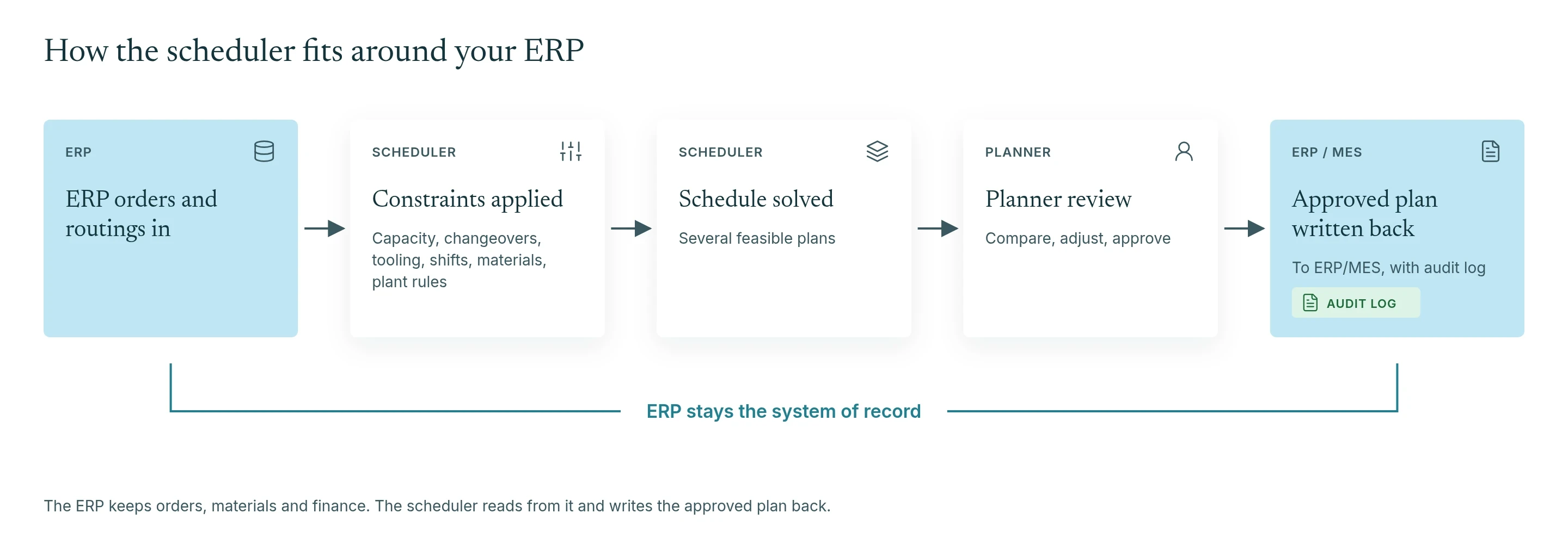
1. It reads what the ERP already knows
Production orders, routings, bills of materials, work-center calendars and inventory status come straight from the ERP. Nobody re-keys anything. The ERP stays the system of record.
2. It applies the constraints your planners carry in their heads
Line capacity, tooling, operator shifts and skills, maintenance windows, materials against stock and inbound purchase orders, and sequence-dependent changeover times from the plant's own changeover matrix. Then the plant-specific rules. At a dairy FMCG manufacturer, the scheduler had to honour blast-freezer curves, because a run that clashes with freezer capacity can't happen whatever the ERP says.
Writing these rules down is usually the most valuable hour of the whole project. Plenty of them have never been written anywhere.
3. It solves for several feasible plans, not one "optimal" one
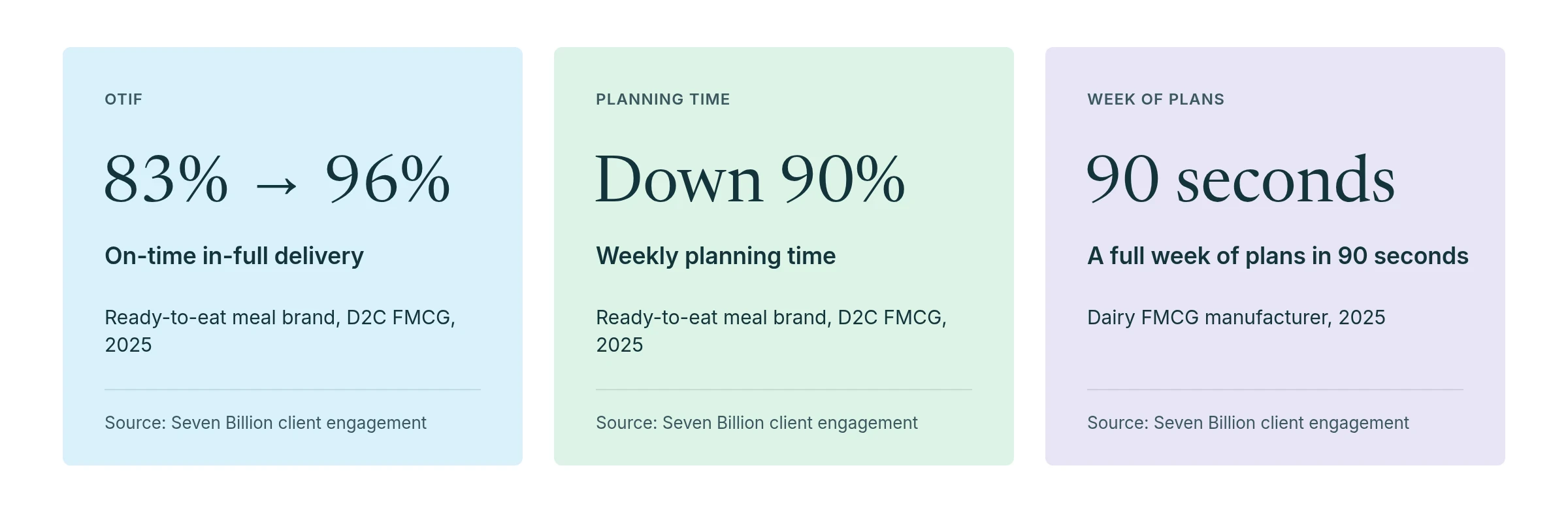
People call the output an optimised schedule. That's not quite right. There's rarely one best plan: there are several feasible ones that trade changeovers against overtime against late orders. The solver underneath is a constraint-programming and mixed-integer model (CP-SAT / MILP), and its job is to find those options fast. At the dairy manufacturer, a full week of plans generates in 90 seconds.
4. The planner compares and chooses
The system lays the options side by side with their trade-offs: this plan adds a changeover but protects two key-account orders; that one runs lean but slips a low-priority batch by a day. The planner picks, adjusts and approves. Every assumption behind the plan is logged.

5. The approved plan goes back to the ERP or MES
Approved schedule slots are written back to the ERP or MES with an audit trail. Which systems and connectors a project uses is confirmed in the architecture session, against the plant's own ERP data and schemas.
How changeovers come down
Changeovers fall when similar products run back to back. The scheduler groups orders into product families using the changeover matrix and avoids setup-heavy transitions wherever due dates allow. The due dates are the brake: a plan with zero changeovers and late orders isn't a good plan, and the trade-off is visible to the planner before anyone commits.
The cost of getting this wrong can be large. At the dairy manufacturer, overlapping runs and freezer bottlenecks were costing ₹46 lakh in changeovers each season before the scheduler went in.
What happens when a line breaks or a rush order lands
The scheduler re-solves with the new constraint instead of starting over. It shows which orders move, which ones become late and by how much, so the conversation with sales starts from facts. At the dairy manufacturer, planners test five scenarios in under five minutes, and the system can run 200 scenarios on demand.
Live plant data makes this faster. At a four-line snacks plant, line data used to arrive once a day, hiding micro-stoppages that cost 6% of OEE and drove overtime. With data latency now averaging 3 seconds, five stoppages were averted in the first month, saving ₹25 lakh. That's a plant-data result rather than a scheduling one, but it's what a re-plan runs on. More in manufacturing analytics and predictive maintenance ROI.
What the results look like by plant type
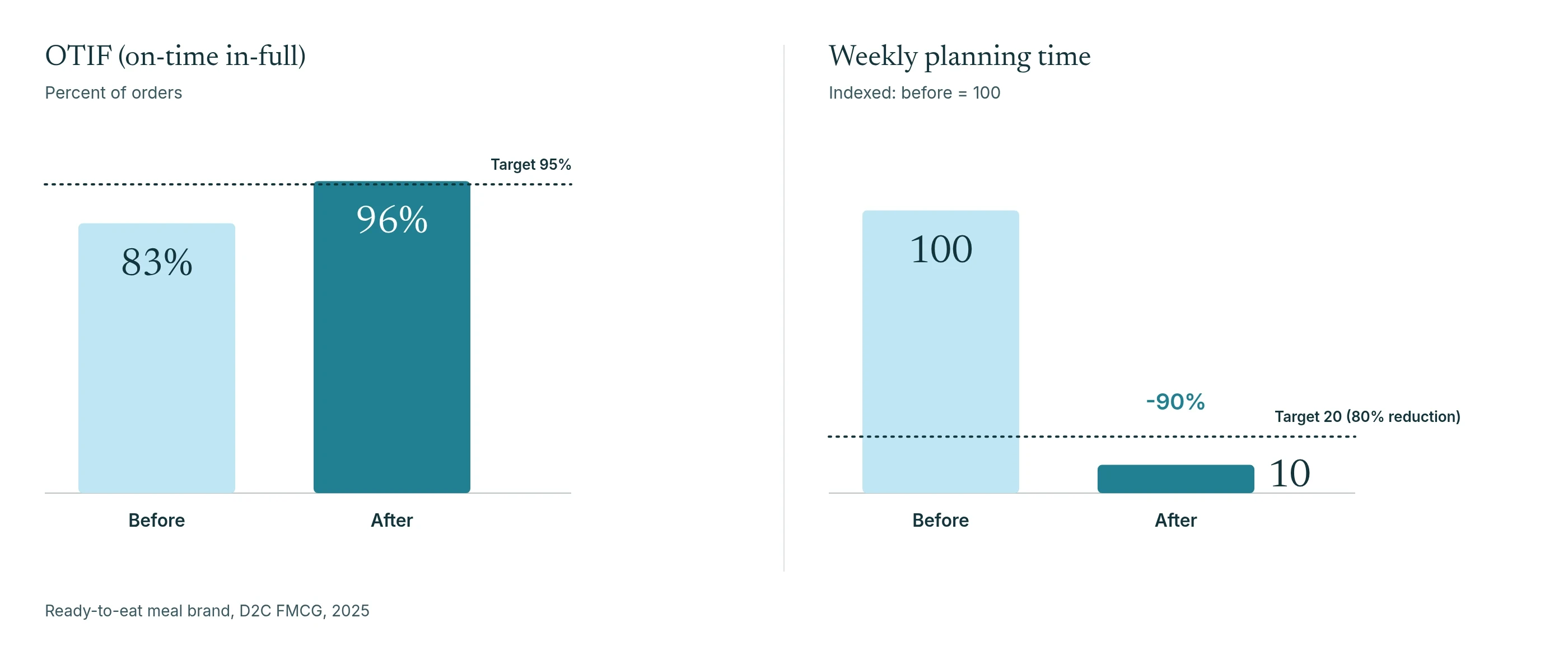
Ready-to-eat meal brand (D2C FMCG, 2025). The planning engine proposes several feasible weekly plans, explains the trade-offs, and pushes the chosen one into the transport system each night. Planning time fell 90% against an 80% target, and OTIF went from 83% to 96% against a 95% target. Freight and re-handling costs also fell ₹1.6 crore a year, which nobody had set as a goal.
Dairy FMCG manufacturer with freezer-constrained lines (2025). A week of plans in 90 seconds, and five scenarios in under five minutes, from a scheduler that respects blast-freezer curves and logs every assumption for audit.
Food producer (2025). A batch-sizing optimiser helped cut lost sales 25% and waste 15%, and freed capacity for new channels.
Results depend on the plant's starting point, which is why the baseline gets measured before anyone sets a target.
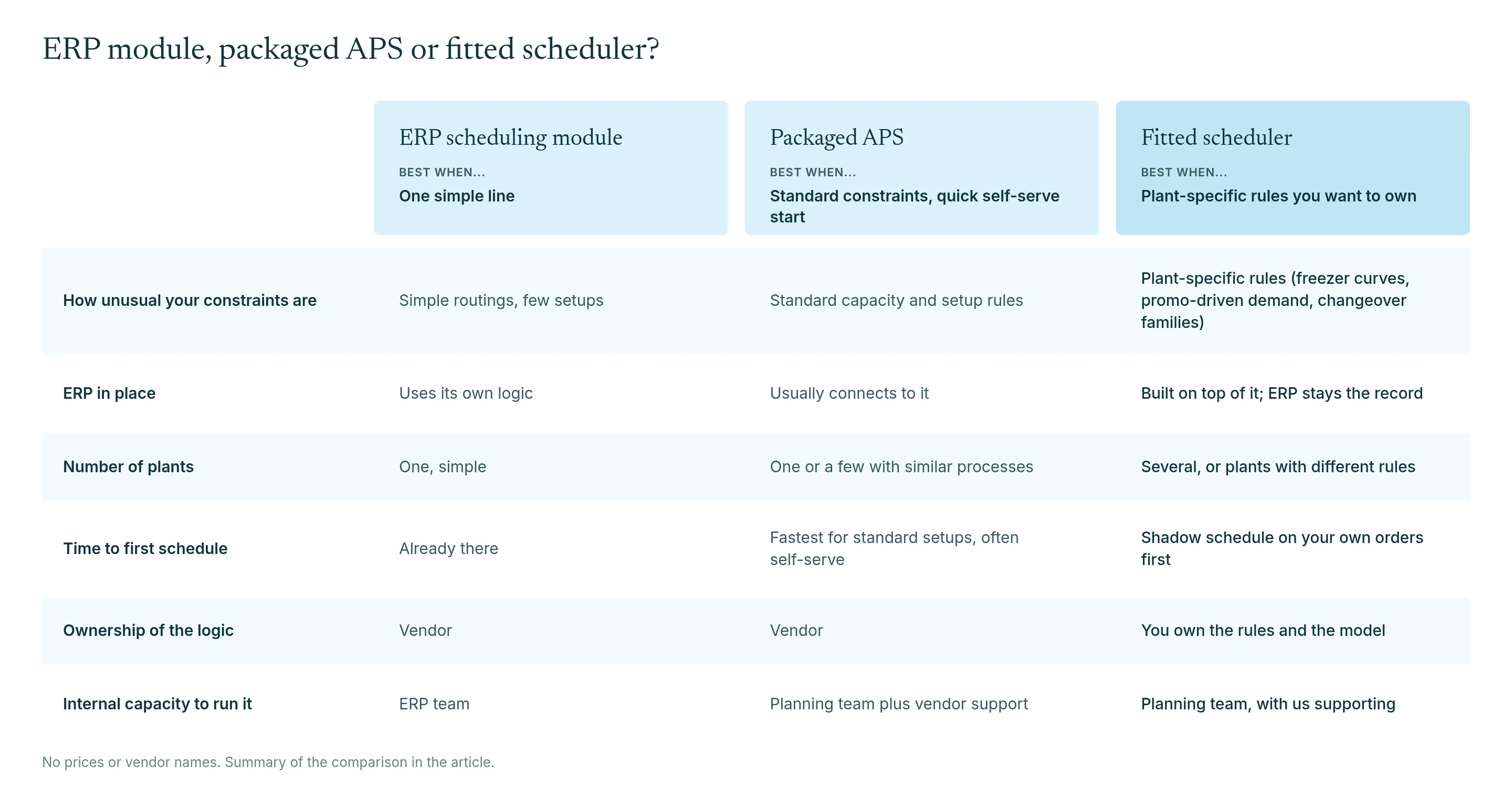
ERP module, packaged APS or fitted scheduler?
There are three ways to get a finite-capacity schedule, and each one fits a different plant.
The ERP's own scheduling module fits one simple line with few setups. It's already there.
A packaged APS tool fits standard capacity and setup rules at one plant or a few similar ones, and it offers the fastest self-serve start. Plenty of plants should buy one.
A fitted scheduler fits plant-specific rules (freezer curves, promo-driven demand, changeover families), several plants with different rules, or a plant that wants to own the scheduling logic.
If demand moves faster than your planning cycle, the forecast matters as much as the schedule. See why an accurate forecast can still lead to the wrong inventory decision and data-driven FMCG demand planning.
How plants usually start
It starts with an architecture session. Engineers inspect the ERP data and schemas, the routings and the changeover rules, and agree with the planners on what "a good schedule" means in that plant: OTIF, changeovers, overtime, or all three in a set order.
Then comes a shadow prototype on the plant's own ERP data. It runs alongside current planning, on real orders, without touching production. Planners compare its schedules against their own, and the plant decides on evidence. How fast this goes depends on the quality of the routing and changeover data and the number of lines in scope, and the timeline is agreed at the end of the architecture session.
FAQ
What is production scheduling software?
Production scheduling software decides which order runs on which line, in what sequence and when, using capacity, changeover rules and due dates. It turns a list of orders into a schedule the plant can execute, and updates that schedule when a breakdown, rush order or late material changes the picture.
What is finite capacity scheduling?
Finite capacity scheduling treats each machine, shift and tool as limited, and places orders only where capacity exists, so the plan can actually run. Infinite-capacity planning, common in basic ERP logic, ignores those limits and leaves planners to fix overloads by hand, which is where most late orders and overtime start.
Do I need to replace my ERP to get better scheduling?
No. The ERP stays the system of record for orders, materials and finance. The scheduler reads orders and routings from it, builds the plan, and writes the approved plan back after a planner signs off. The plant keeps its ERP exactly as it is.
How is a scheduler different from MRP?
MRP works out what to make and when materials are needed, usually from fixed lead times. A scheduler works out the exact sequence on each line given capacity, changeovers and priorities. MRP feeds the scheduler its orders and material dates, and the scheduler turns them into a plan the plant can run.
How does AI scheduling handle a machine breakdown or a rush order?
It re-solves the plan with the new constraint, shows what moves and what becomes late, and lets the planner compare options before approving one. At one dairy FMCG manufacturer, a full week of plans generates in 90 seconds, and planners test five scenarios in under five minutes.
Can it cut changeovers and improve OTIF?
Yes, that is the core job: sequencing orders to reduce changeovers while protecting due dates. At one ready-to-eat meal brand, OTIF rose from 83% to 96% in 2025, and planning time fell 90%. Each plant starts from a different baseline, so the baseline is measured in the shadow prototype before a target is set.
Is this better than an off-the-shelf APS?
Not always. A packaged APS suits standard constraints, a single plant and a quick self-serve start. A fitted scheduler wins when the rules are unusual, for example freezer curves or promo-driven demand, when the plant wants to own the scheduling logic, or when a packaged tool can't be adapted to how the plant actually runs.
Which ERPs and MES systems does it connect to?
The specific connectors are confirmed system by system in the architecture session, where our engineers inspect the plant's ERP data and schemas. The pattern is the same whatever the ERP: orders and routings come in from it, and approved schedule slots go back to the ERP or MES with an audit trail. The ERP stays the system of record throughout.
How long does it take to get a first schedule?
The first schedule comes from a shadow prototype built on the plant's own ERP data, after an architecture session. Its timing depends on the quality of the routing and changeover data and the number of lines in scope, and the timeline is set at the end of the architecture session.
Who owns the schedule, the planner or the AI?
The planner. The system proposes feasible plans and explains the trade-offs in each; the planner compares, adjusts and approves. Nothing goes back to the ERP or the floor without that approval, and every assumption behind a plan is logged for audit.
Where to go from here
If your plant is outgrowing the spreadsheet, our AI production scheduling page shows how the scheduler fits on top of your ERP and what a shadow prototype on your own orders looks like. Or book an architecture review directly.
KEEP READING
Explore more perspectives on AI, analytics, and enterprise intelligence.